Electromigration is a very critical issue in integrated circuit design, especially at lower technology nodes. Since the cross-sectional area of metal interconnections becomes very small, the electro-migration effect becomes more and more significant. Simply put, the electromigration effect refers to the phenomenon that electrons migrate in metal wires when they are subjected to a large current.
Electromigration mechanism:
When high current densities pass through metal interconnects, the momentum of the current carrier electrons may be transferred to the metal ions through collisions, causing the ions to move in the direction of the electron flow, a phenomenon known as the electromigration effect. The current density J is defined as the current per unit cross-sectional area, i.e.
Among them:I is the current and A is the interconnection cross-sectional area.
As technology nodes shrink, the cross-sectional area of metal interconnects decreases and current density increases significantly in lower technology nodes. Electromigration has been a challenge since the 90nm technology node, especially at lower nodes such as 28nm and below.
Electromigration phenomenon:
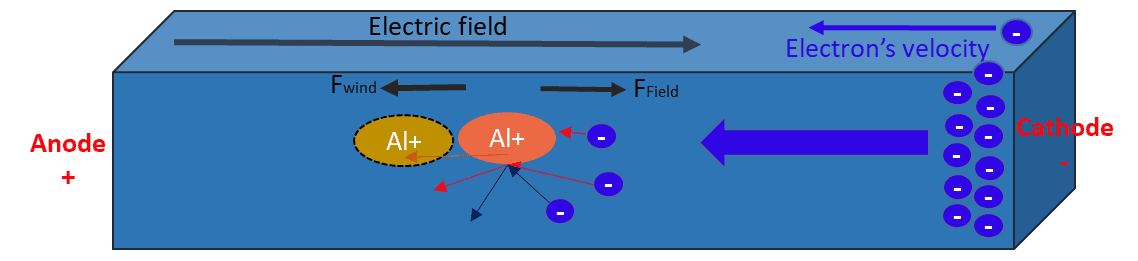
Figure 1 Electromigration phenomenon
Figure 1 illustrates the phenomenon of electromigration effect: applying a potential difference between metal interconnections creates an electric field from anode to cathode, causing electrons to move in the opposite direction of the electric field, thereby generating an electric current. These moving electrons have momentum, which causes the ions to drift when they collide with metal ions. If the current density is high, the force of the electron wind will exceed the force of the electric field.
Electromigration problems may affect the interconnect immediately or may not become apparent until months or even years into operation, depending on the current density. Therefore, the reliability of ASIC (Application-Specific Integrated Circuit) will be affected by the electromigration effect.
Mean time to failure (MTTF) is a key metric for evaluating the life of integrated circuits. The MTTF is calculated using Black's equation as follows:

Among them:
A = cross-sectional area
J = current density
N = scaling factor (usually set to 2)
Ea = activation energy
K = Boltzmann constant
T = Kelvin temperature
Effects of electromigration:
Once the metal ions start moving from their original location, they will cause problems in the interconnect. This can lead to either too much accumulation of ions at a certain location or not enough ions. Therefore, bloat or voids may appear in the interconnect.
In addition, when electrons flow through a metal wire, they will collide with atoms in the metal wire. The collision causes the metal's resistance to increase and generate heat. If a large number of electrons collide with metal atoms within a certain period of time, the metal atoms will flow in the direction of the electrons. This will cause two problems: first, the moved atoms will leave a vacancy in the metal, and if a large number of atoms are moved, the connection will be broken; second, the moved atoms must stop in a certain place, forming a large accumulation at the end of the current direction. Taking copper wires as an example, the skin effect of current causes electrons to move on the surface of the copper wires. When a collision occurs, the atoms on the surface are continuously moved towards the end of the wire by the impact. Where atoms leave, the copper wire continues to become thinner or even disconnected. Where atoms accumulate, the copper wire continues to grow thicker and may even come into contact with surrounding copper wires, causing a short circuit.
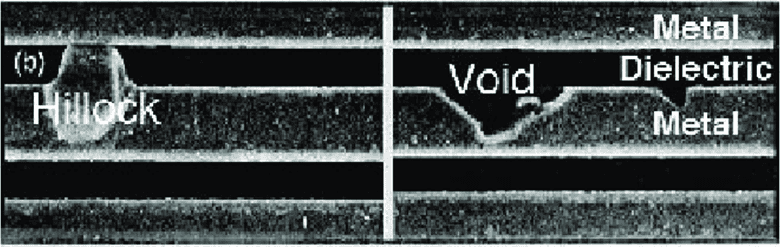
Figure 2 Swelling and void formation in interconnects
Figure 2 shows the expansion and void formation.
void: If the incoming ion flux is less than the outgoing ion flux, a void is created in the interconnect. Voids can cause discontinuities in the interconnect, leading to open circuits.
Expansion: If the incoming ion flux is greater than the outgoing ion flux, this can cause ions to accumulate and create swells in the interconnect. The expansion may increase the width of the metal interconnects and touch adjacent metal interconnects, potentially causing short circuits.
Prevention techniques for electromigration:
As technology nodes shrink, the interconnects used change. Initially, pure aluminum was used for interconnects, then the industry started using Al-Cu alloys and later moved to copper interconnects. Compared to aluminum interconnects, copper interconnects can handle approximately 5 times the current while maintaining similar reliability requirements.
Factors that affect the EM capability of materials include: wire length, wire radius, current density, temperature, and flow time.
The longer the wire, the more atoms there are
The smaller the radius of the wire, the smaller the electron distribution area and the more concentrated the electrons are.
The greater the current density, the greater the number of electrons
The higher the temperature, the greater the energy of the electrons and the more active the atoms
The longer the flow time, the more collisions occur
During the physical design process, the following techniques can be used to prevent electromigration problems.
- Increase metal width to reduce current density
- reduce frequency
- Reduce supply voltage
- Keep wire lengths short
- Reduce buffer size in clock lines
To prevent electromigration issues, electromigration checks will be performed during the physical signoff phase to comply with the electromigration rules provided by the fab.
thank you
[1] https://blog.csdn.net/m0_61623740/article/details/120162795
[2] https://teamvlsi.com/2020/08/electromigration-effect-in-vlsi.html