During the chip manufacturing process, transistors placed at the boundaries of standard cells are easily damaged. In order to prevent this damage at the boundary, there is a special type of unit in the standard unit library called a boundary cell, also called a boundary cell. The boundary unit can not only protect the transistor damage at the boundary, but also avoid or mitigate the impact of PSE and OSE. This article will discuss the necessity of boundary cell layout, the structure, layout and use of boundary cells.
1 Placement of boundary elements:
Boundary cells are placed at both ends of each row to terminate the row, and around memory or other blocks to integrate with other blocks. Some standard cell libraries also have corner end cap cells, which are used to place the corners of blocks. Boundary elements have fixed properties, so these elements cannot be moved during the optimization process. Figure 1 shows a typical layout with boundary cells placed at the end of rows. The function is to ensure that each nwell is nwell enclosed, similar to a closed ring.
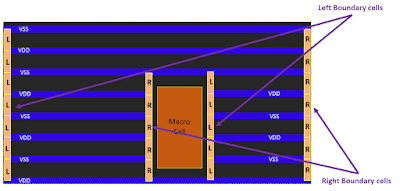
Figure 1 Layout with boundary cells placed at the end of rows
2 Why do we need to place boundary elements?
The reasons for placing boundary elements are as follows:
Protect standard cells: Standard cells at the boundary are susceptible to damage. In order to reduce this damage, boundary cells need to be placed at the boundary. The boundary cell has a dummy poly gate, which can prevent the normal standard cell function from being affected when damage occurs at the boundary.
Prevent irreversible damage: If the boundary cell is not placed at the boundary, it may cause irreversible damage to the function of the chip.
Avoid DRC (Design Rule Check) errors: There must be no gap between the well and implant layers, otherwise DRC errors will occur. The existence of boundary cells ensures that there is no gap between the well and implant layers.
Prevent the source/drain from appearing at the boundary: The poly extension of the boundary cell can ensure that the source/drain of the standard cell does not appear at the boundary.
Satisfy boundary requirements: Placing the boundary cell on the boundary of the row can satisfy the well tie requirement of the boundary.
3 Layout of boundary cells:
Boundary cells are cells that have only physical functionality, so these cells are not part of the netlist. The boundary unit mainly has Nwell layer, implant layer, virtual polycrystalline layer and metal guide rail, as shown in Figure 2.
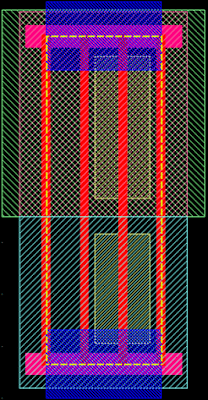
Figure 2 Structure of boundary element
4 Placement method:
Boundary cells are placed after macro placement and site row creation. Boundary cells are placed before standard cells are placed and are therefore called pre-placed cells. Capacitor cells can be added via the GUI interface or via tool commands. Below are the commands to add end cap cells in Innovus and ICC tools.
(1) For Innovus tools:
setEndCapMode -reset setEndCapMode -rightEdge <CellName> -leftEdge <CellName> -topEdge <CellName> -bottomEdge <CellName> -rightTopEdge <CellName> -rightBottomEdge <CellName> -leftTopCorner <CellName> -leftBottomCorner <CellName> addEndCap -prefix <name>
verifyEndCap -report <reportName>
(2) For ICC tools:
insert_boundary_cell
For more information about these commands and related switches, refer to the tool's command manual.
thank you
Original link:https://teamvlsi.com/2020/08/end-cap-cell-in-vlsi-boundary-cell-in.html
https://www.cnblogs.com/duxinshupd/p/15925167.html