Flip-flops are a critical element in physical designs for storing and transmitting digital information. First, let's focus on single-bit flip flops [single-bit flip flops: SBFF]. This is a basic flip-flop that can store one bit of information. A single-bit flip-flop consists of several gate circuits, usually implemented with an inverter and a two-input logic gate (such as an AND gate, OR gate, etc.). They have a storage function that saves input information and transfers it to the output when the rising edge of the clock arrives. In digital circuits, single-bit flip-flops are the most basic and common memory cells.
Traditionally, we in academia only study single-bit flip-flops. When we need to store multiple bits, the storage capacity of a single-bit flip-flop is not enough. At this time, multi-bit flip flops [multi-bit flip flops: MBFF] come in handy. Multi-bit flip-flops can store multiple bits of information at the same time and transmit all the information at once when the rising edge of the clock arrives. In modern ASIC designs, the use of multi-bit flip-flops has increased because it has many attractive advantages over single-bit flip-flops. Therefore, it becomes important to understand the design of multi-bit flip-flops, how they work, and the advantages and disadvantages of multi-bit flip-flops over single-bit flip-flops.
Why use multi-bit flip-flops?
A multi-bit flip-flop is composed of multiple single-bit flip-flops, forming a matrix of memory cells. The most common multi-bit flip-flops are D flip-flop (D Flip-Flop) and JK flip-flop (JK Flip-Flop). D flip-flops store and transmit information through a data input (D) and a clock input (CLK). The JK flip-flop has two inputs: trigger input (J and K) and clock input (CLK). Multi-bit flip-flops can implement different storage units according to different functional requirements to meet the needs of different design scenarios.
Multibit flip-flops have many advantages due to their architectural advantages. There are also many recent research publications showing these facts and providing appropriate statistics. We also see these advantages during place and route (PnR) implementation. Here, I would like to briefly explain the basic facts of MBFF without going into detailed statistics. Exact statistics can be consulted from any recent research publication. The main advantages of multi-bit flip-flops are as follows, which is why MBFF is widely used nowadays.
- Reduce area and reduce power consumption (attractive to low-power designs):
Single-bit flip-flops can only store one bit and are suitable for simple storage needs. Multi-bit flip-flops can store multiple bits at the same time and are suitable for larger and more complex storage requirements. Because multi-bit flip-flops have higher memory capacity and complexity, they typically occupy larger area and generate higher power consumption. In comparison, single-bit flip-flops are relatively small in terms of area and power consumption due to their smaller storage units.
- Better clock skew control:
Multi-bit flip-flops typically have more complex timing and synchronization control capabilities. In design, multi-bit flip-flops can provide more flexible timing control, such as batch transmission of data, synchronization sequence generation, etc. The single-bit flip-flop is more used for simple timing control.
- Improve timing:
Multi-bit flip-flops typically have more complex timing and synchronization control capabilities. In design, multi-bit flip-flops can provide more flexible timing control, such as batch transmission of data, synchronization sequence generation, etc. The single-bit flip-flop is more used for simple timing control.
Therefore, it can be said that it improves area, power consumption and timing.
Multi-bit flip-flop architecture:
All the advantages of multi-bit flip-flops are due to their architecture. Figure 1 shows the schematics of a single-bit flip-flop and a 2-bit multi-bit flip-flop. The same architecture can also be imagined for higher bit multi-bit flip-flops.
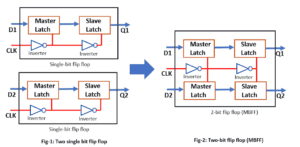
Figure 1 Multi-bit flip-flop
One can notice that the number of inverters is reduced when we use multi-bit flip-flop compared to single-bit flip-flop. This reduction is even more pronounced when we use larger multi-bit flip-flops. Figure 2 shows the comparison of the number of inverters in SBFF and MBFF.

Figure 2 Number of inverters used in SBFF and MBFF
There are 16 inverters in 8 single-bit flip-flops, while only 2 inverters are used in 16-bit flip-flops. Figure 3 shows a schematic diagram of an 8-bit multi-bit flip-flop.
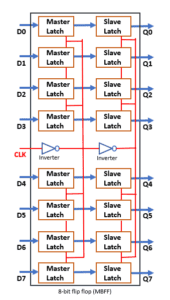
Figure 3 8-bit multi-bit flip-flop
Since the number of inverters of a multi-bit flip-flop is reduced, it saves clock power and area. There is no change in the operation of the flip-flop after the MBFF conversion. Now let us discuss the mechanism of how PnR tool converts SBFF to MBFF.
MBFF conversion:
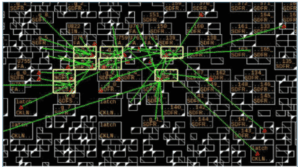
Figure 4 Placement before MBFF conversion
Figure 5 Situation after MBFF conversion
Figure 4 and Figure 5 show the process of converting SBFF to MBFF. Figure 4 shows the situation before MBFF conversion, while Figure 5 shows the situation after MBFF conversion. In Figure 5, we can see that an 8-bit MBFF is used instead of 8 different SBFFs. Therefore, MBFF is usually larger and has standard cells with multiple row heights.
PnR tools have algorithms to convert SBFF to MBFF. The tool selects an equivalent MBFF from a standard cell library and performs the conversion based on the user-supplied conversion input. This conversion process occurs during the layout phase.
If we talk about Cadence Innovus tool, we have a command:
setOptMode -multiBitFlopOpt true
This command enables the PnR tool for multi-bit flip-flop conversion. By default, the tool disables this conversion feature. There are many other commands in this tool for further exploration.
By comparing multi-bit flip-flops and single-bit flip-flops, we can see that they play different roles in the physical design. Single-bit flip-flops are our most common storage units, while multi-bit flip-flops play an important role when it is necessary to store large amounts of information and implement complex functions. They each have their own advantages and applicable scenarios, and we need to choose and use them according to actual needs. Mastering the characteristics and applications of these two flip-flops will help us better exert our creativity in physical design and improve efficiency and performance.
link
[1] https://teamvlsi.com/2021/04/multi-bit-flip-flop-vs-single-bit-flip-flops.html
[2] https://blog.csdn.net/qq_37000411/article/details/124377038
[3] https://blog.csdn.net/qq_39005414/article/details/115384339